How Encryption Is Described on Adult AI Platforms
Encryption wording on an adult chat platform describes how data travels and how it is stored — it does not describe who can see the screen you are reading from. That distinction matters because a reader who averages an hour per session sixteen times a month is spending 16.0 hours a month inside a chat window, and most of that exposure is decided by the device, not by the transport layer.

Key takeaways
- Transport, storage and anonymity are three separate claims. A page can make the first two and never make the third.
- The strongest wording you will find is comparative, not absolute: state-of-the-art encryption is a statement about method, not a promise about outcomes.
- Session time sets the exposure window. Sixteen one-hour sessions a month is 16.0 hours that a shared screen could be observed.
- On a text-only platform, the sensible privacy question shifts from "what is being recorded" to "who else can read this screen".
What an encryption claim actually covers
There are two places a claim like this can point. The first is the connection between your device and the service — the data in transit. The second is the copy that rests on the service's own storage afterwards. A page that says it provides a private and secure environment is describing both in one phrase, which is efficient marketing and unhelpful engineering: the two protections are implemented differently and fail differently.
What no amount of transport or storage encryption addresses is your local situation. A chat window left open on a shared laptop is fully readable by the next person who sits down, whatever the encryption in between. This is not a flaw in the platform's wording; it is simply outside the scope of the sentence, and it is where most of the practical risk for a reader actually sits.
Three claims that look similar and are not
The first claim is that traffic is encrypted. This is now close to universal and says little more than that nobody is reading packets in transit. The second is that stored conversations are protected, which is a stronger operational commitment but still says nothing about who inside a service could access a record.
The third claim — that a reader is anonymous — is the one adult platforms generally avoid, and for good reason. An account, a subscription and a device all create links. What Crushon publishes instead is narrower and more honest: a private and secure environment, state-of-the-art encryption, and full privacy and discretion as a design goal. It also states, in its compliance documentation, that its content is AI-generated text and depicts no real person, which changes the privacy question entirely compared with services built on recordings of identifiable adults.
| Wording you will see | What it typically covers | What remains your responsibility |
|---|---|---|
| State-of-the-art encryption | Protection of data moving between you and the service | Nothing on the platform side; everything on the device side |
| Private and secure environment | The service's own handling and storage of conversations | Your account hygiene and who else uses your hardware |
| Full privacy and discretion | Product intent: no public profile, no feed of your activity | Notification previews and open tabs |
| AI-generated text, no real person depicted | The nature of the content itself | Nothing — but it is the reason the risk profile differs from recorded media |
| Some limitations apply under the guidelines | That "unfiltered" is not the same as unmoderated | Reading the guidelines before assuming a rule does not exist |
A practical way to compare two pages is to write the claim on one line and the evidence on the next. "State-of-the-art encryption" on the first line, and on the second line the question of what it protects and whether the page says so. "Private and secure environment" on the first line, and on the second the observation that this describes the service's handling rather than your household. Claims that survive that treatment are the ones worth relying on; claims that collapse into vague reassurance are worth discounting before you create an account.
Worked example
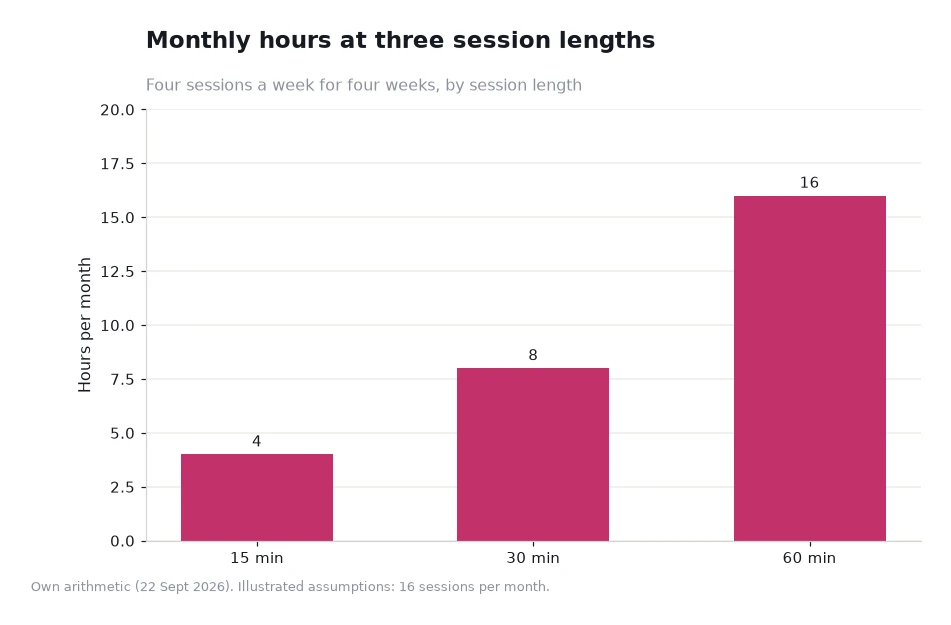
Convert a habit into an exposure window. Suppose sixteen sessions a month — four a week across four weeks. At fifteen minutes each that is 4.0 hours a month. At thirty minutes it is 8.0 hours. At an hour it is 16.0 hours, which is about 3.7 hours a week.
The arithmetic changes which privacy measures are worth bothering with. If your monthly total is 4.0 hours, a single unlocked device is a small window and a lock screen is a sufficient measure. At 16.0 hours the window is large enough that habits matter more than settings: a dedicated browser profile, notifications set to hide content, and a rule that a session ends when someone else sits down. None of those measures touches encryption. All of them are the part of privacy the platform cannot provide. The useful way to think about it is that the two layers are additive: the service reduces what can be observed in transit, and you reduce what can be observed in the room.
Reading the wording before you trust it
The useful habit is to read the vendor's own sentence rather than a summary of it. On the porn ai landing page the privacy claim is short, specific and measurable in a way that broad marketing language is not: encryption named as a method, privacy named as a property of the environment. Compare that with the absolute phrasing you sometimes see elsewhere — total anonymity, nothing ever stored — which no serious service can underwrite and which should make you trust the page less, not more.
Then check the parts that are easier to verify than an encryption claim. The platform's own FAQ entry on what Porn Chat AI means frames the product as a text conversation with a character you can shape, which is a narrower and more accurate description than the phrase's shorthand suggests. The compliance statement published under the 2257 compliance statement sets out what the content is and is not, and the content removal policy documents how a reader can report a page. A service that publishes a removal route and an age-compliance statement is telling you more about its housekeeping than any adjective about security.
Frequently asked questions
Does encryption make a chat private from the service itself?
Not by itself. Encryption as usually described protects data in transit and at rest; it does not by itself determine who inside an organisation can access a record.
Is state-of-the-art encryption a guarantee?
It is a description of the method used. Read it as a statement of intent and implementation, not as a promise about every possible outcome.
What is the biggest privacy gap on a chat platform?
Usually the local device. Open tabs, notification previews and shared logins reveal more in practice than anything happening in transit.
Judge the wording, then manage the device
Treat published privacy language as one input among several: read it, note what it does not claim, and then handle the part that is yours. For most readers that means a screen lock, a clean notification setting and a private browser profile — small measures that cover the 4.0 to 16.0 hours a month the arithmetic above describes.
References: the platform's privacy wording and AI porn chat landing page[1], its compliance statement and removal policy, all read 22 Sept 2026. Session-hour figures are illustrative assumptions. Read 22 Sept 2026. Written for adult readers aged 18 and over.