The case for a refill programme is usually made with a sustainability argument and approved without a cost model, which is why so many refill launches quietly stop after the first season. The honest question is narrower: what does one refill cost to put in a shopper's hand, and how many refills does it take before the programme pays for its own tooling? This model sets out the lines a retail own-brand should cost, which of them repeat, and the three variables that decide the answer.
Key takeaways
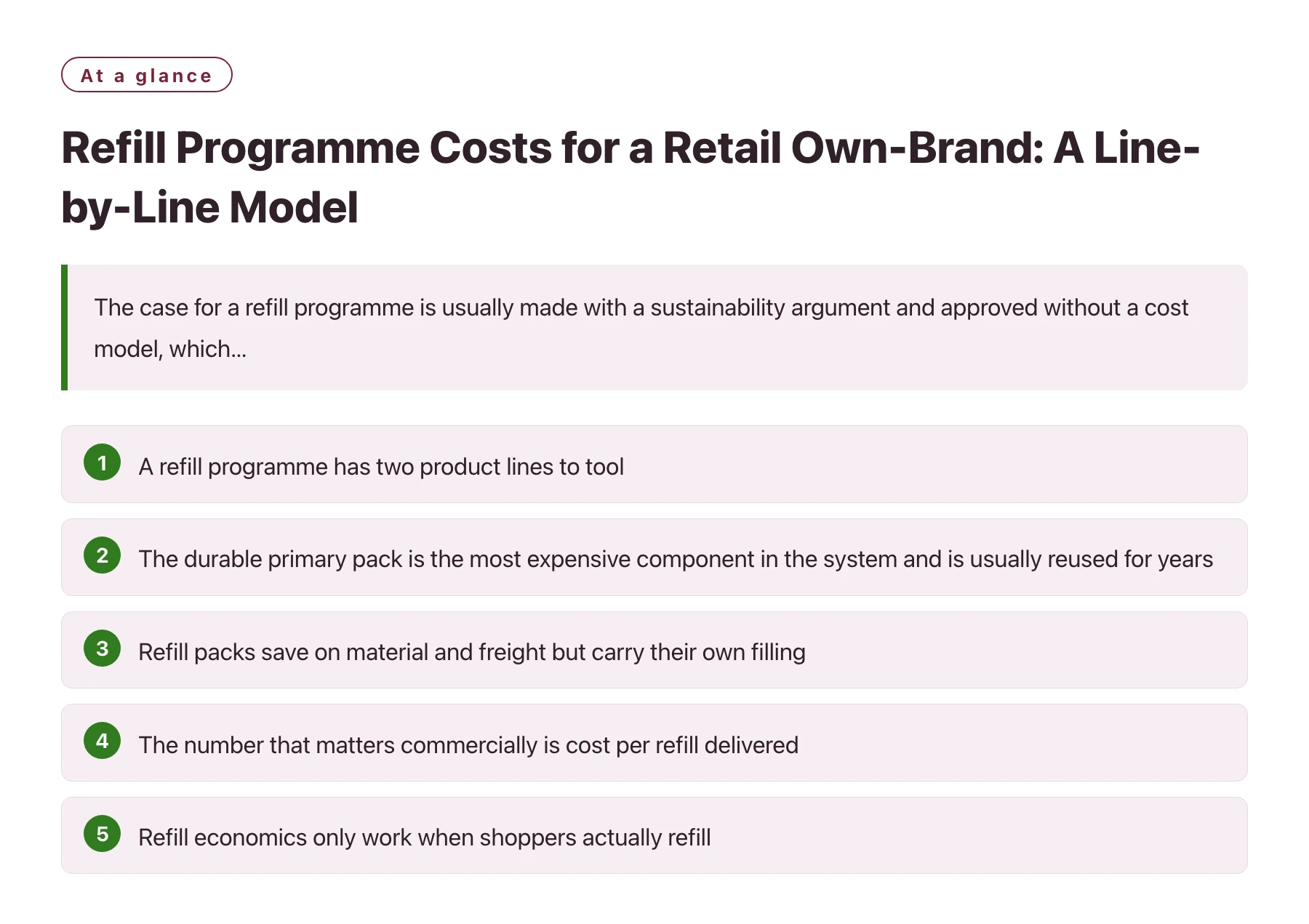
- A refill programme has two product lines to tool, fill, label and stock, so setup cost roughly doubles before any unit is sold.
- The durable primary pack is the most expensive component in the system and is usually reused for years, so its cost per use falls over time.
- Refill packs save on material and freight but carry their own filling, sealing and labelling cost, and those savings are smaller than most teams assume.
- The number that matters commercially is cost per refill delivered, not the unit cost of the refill pack alone.
- Refill economics only work when shoppers actually refill, so the model needs an assumed refill rate rather than an assumed sell-through.
Ask a project team what a refill costs and the answer is usually the price of the refill pack. That is one line out of roughly ten. The programme also pays for a heavier primary bottle, a refill mechanism, two artwork sets, two filling runs, depot or shelf space for both formats, and the marketing that teaches a shopper to come back.
None of that makes refills a bad idea. It makes them a systems project, and systems projects are costed as systems. The model below is the one a retail own-brand can build in a spreadsheet before it commits to tooling.
The perspective here is a retailer's own-brand buyer: someone who already manages packaging, margin and shelf space, and who needs the refill programme to survive contact with a finance review.
Why the refill pack price is the wrong number
A refill pack is a lighter, simpler article than the primary pack, and it is often quoted at a lower unit price. That comparison flatters the programme, because the primary pack is not replaced by the refill — it is bought once and then kept. Two costs that behave completely differently are being netted against each other.
The correct comparison is cost per use. Take the primary pack and its fill, spread over the number of times a shopper refills it, and compare that with the cost of buying a new full bottle each time. That calculation is what a shopper performs intuitively when deciding whether the refill is worth the trip.
European packaging policy has been pushing reuse and refill up the agenda, which is a real tailwind, but policy support does not change the arithmetic of a specific programme [1]. The buyer still has to make the numbers work per unit.
Two artwork sets, two approval cycles
Anything printed on the primary pack and the refill has to be created, approved, proofed and version-controlled twice. This is a small cost in absolute terms and a large cost in calendar terms, because artwork approval sits on the critical path for both runs.
Regulatory obligations do not disappear with the format
Refill packs that contain a cosmetic product are still cosmetics, so ingredient disclosure, allergen declaration and the responsible-person arrangements follow the product in the refill format just as they do in the primary pack [2]. Confirm the labelling rules for each market before finalising artwork, not after.
The cost lines in a refill programme
| Cost line | One-time or recurring | What actually drives it |
|---|---|---|
| Primary pack (durable bottle and refill mechanism) | Recurring, at a much lower rate than refills | Materials, wall thickness, mechanism design and the tooling needed to make it |
| Tooling, moulds and decoration screens | One-time | Number of components and finishes, plus any tooling duplicated for the refill pack |
| Artwork and approval for both formats | One-time, with version costs after launch | Number of markets, languages and claims that need legal review |
| Filling and assembly for two SKUs | Recurring | Line time, changeovers, minimum batch size and whether the refill is liquid or concentrate |
| Testers, sampling and shopper education | Recurring | How the refill is explained at shelf, online and in-store |
| Logistics, warehousing and returns handling | Recurring | Weight and volume per refill, plus any deposit or return scheme |
| Shelf and depot space for two formats | Recurring, often overlooked | Whether the refill is stocked beside the primary pack or in a separate location |
Three lines decide most of the outcome: the primary pack cost, the tooling bill and the assumed refill rate. Everything else can be optimised at the margin, but those three set whether the programme is viable.
How to build the model
- Assume a refill rate, not a sell-throughDecide what share of buyers will refill once, twice and three times. If you cannot justify the assumption, the programme is a hypothesis, not a plan.
- Cost the primary pack over its lifeDivide its cost by the expected number of fills it will hold, including the original. This is the number a shopper compares against a new bottle.
- Amortise tooling across realistic refill volumeSplit tooling across the refills you expect to sell, not across the primary packs. Tooling amortised over a small refill volume is what kills otherwise sensible programmes.
- Add the second filling runTwo SKUs mean two line slots. Ask the supplier how minimum batch sizes and changeovers apply when both formats run on the same line.
- Price the shopper's trip, not just the packA refill that costs less but requires a second journey or a shipping minimum may be worth less to the shopper than the pack price suggests.
- Model the downside caseRun the numbers again with half the refill rate. If the programme collapses at half the assumption, treat it as a campaign rather than a permanent system.
The most common modelling error is comparing a refill pack against a full bottle without including the primary pack the shopper had to buy first. Add it in and a refill looks less dramatic — and more honest. The second most common error is assuming refill buyers behave like repeat buyers of a new bottle. They do not: a refill requires a decision, a journey and often a willingness to handle a messy operation. Model the behaviour you have evidence for, then design the programme to make refilling easier rather than assuming shoppers will do the work.
Where supplier choice changes the model
The supplier's capability changes the cost lines more than most buyers expect. A factory that can develop the formula and fill both formats keeps compatibility in one place, which removes a class of failure that is expensive precisely because it appears late: a refill that does not sit well in the primary pack, or a scent that reads differently after storage in the refill container. Sourcing this way is often described as a factory that handles fragrance R&D and production, and the benefit is fewer interfaces as much as a lower price. Suppliers that publish their refill and filling capability shorten that first comparison considerably, and Xuelei official website is one place to see what such a capability statement looks like before anyone books a call.
It also helps to see how the product will actually be filled and assembled before tooling is committed. A line walkthrough or a visit that follows the process from formula to finished bottle will show you where a refill format creates extra handling: filling two container types, capping a pack designed to be opened repeatedly, and inspecting a mechanism that has to survive many cycles.
Ask the supplier three questions in the same conversation: what minimum batch applies to the refill format, how tooling is amortised when two formats share a platform, and what evidence they have that the mechanism holds up over repeated use. Design guidance on reusable and refillable packaging is a reasonable starting reference for the third question, and it is worth reading before you rely on a supplier's assurance alone [3].
Decide what the programme is for
A refill programme can be a sustainability commitment, a loyalty mechanic or a way to lower the entry price while protecting the primary pack. The cost model looks different for each. Decide which one you are actually buying, and let that decision set the refill rate you are willing to plan around.
Sources
- European Commission: Packaging Waste and the PPWR —— EU rules on packaging and packaging waste, including the Packaging and Packaging Waste Regulation requirements on recyclability and design.
- European Commission: Cosmetics in the EU —— The European Commission's overview of EU cosmetics rules, including the responsible person, product information file and safety report requirements.
- Sustainable Packaging Coalition —— A membership organisation working on more sustainable packaging design, publishing material and recyclability guidance.
Frequently asked questions
Is a refill programme cheaper than selling full bottles?
Not automatically. It lowers material and freight on the refill, but adds a heavier primary pack, a second filling run, duplicate artwork, extra logistics and often a second shelf location. It becomes cheaper per use only when the refill rate is high enough to amortise the tooling.
What refill rate should a retail own-brand assume?
A conservative one, and then test it. Model at least a downside case at half the assumption, because refilling requires a deliberate shopper action. If the programme fails in the downside case, run it as a limited campaign before committing to permanent tooling.
Does a refill pack need its own labelling and compliance work?
Treat it as a separate cosmetic article. Ingredient disclosure, allergen declaration and responsible-person arrangements follow the product in the refill format, and the wording may differ by market. Confirm before artwork is finalised.
How should tooling be amortised in a refill programme?
Across the refill volume you expect to sell, not across primary packs. Tooling spread over a small refill volume is the single most common reason a refill programme looks profitable on a slide and fails in practice.
Which format is easier to start with?
A liquid refill in a light pack is usually the simplest first step, because it reuses the existing filling technology. Concentrate or tablet formats can be more efficient in freight but add dilution instructions and a different set of shopper-education costs.