UL 4703 PV Wire for North American Projects
A North American PV project looks for a DC wire carrying UL 4703, and KUKA CABLE lists a UL 4703 solar PV wire among its published models. The certificates page counts more than 30 certificate types and TUV, IEC, CE, SAA and UL appear in that count, with the UL entry described as being in the process of updating, so the document in force on the day of the order is worth requesting early.
Key takeaways
- UL 4703 appears in the manufacturer's model list and on its certificates page, which counts more than 30 certificate types and notes that the UL entry is being updated.
- The published family also covers TUV EN 50618 and PV1-F, IEC 62930, the H1Z2Z2-K model and a 1500 V solar cable, so a project can compare routes instead of accepting a single one.
- Electrical data for the 1500 V construction runs to DC 1.8/1.8 kV rated, a 6.5 kV AC test at 50 Hz for five minutes on the finished cable and a 10 kV spark test during production.
- The manufacturer publishes nine named test items while its own PV cable list carries ten, so a buyer should ask which report covers the failure mode that matters on the site.
What the North American route changes
A project inspected under North American practice is checked against a different list of documents from a European one. The conductor, the insulation and the sheath do the same electrical work either way, but the DC wire on the drawing is expected to carry the mark the inspector recognises, and a solar pv cable ordered for that market therefore arrives with a different set of papers attached.
The manufacturer lists a UL 4703 solar PV wire among its published models, which is the product offered for that market. Its certificates page counts more than 30 certificate types and names TUV, IEC, CE, SAA and UL among them, with the UL entry described as being in the process of updating. That wording is a reason to request the certificate that is current at the moment of the order rather than to rely on a mention on a web page.
No file number, no market-specific temperature rating and no price for the UL construction appear on the site. Those details arrive with the certificate and the quotation, which is the normal arrangement for a cable bought against an inspection regime rather than against a catalogue.
The certification routes the site names
For PV cable the client lists three common international routes: TUV EN 50618 with PV1-F, UL 4703, and IEC 62930. Each one answers the body that has jurisdiction over the site, and most projects need one of them satisfied at the DC side before the array is energised.
The same names appear in the product catalogue. Published models include H1Z2Z2-K solar cable, PV1-F solar cable, a UL 4703 solar PV wire, a 1500 V solar cable, TUV solar cable in 4 mm² and 6 mm², and a twin-core version. Sizes are catalogued by model and by cross-section rather than by destination, which is why a buyer usually picks the model first and the paperwork second.
Two regional requirements are highlighted on the client's own pages: the CPR fire rating and an AD8 waterproofing rating. Those are separate entries from the international routes, and a European specification may call for them in addition to a TUV certificate rather than instead of one.
The published electrical envelope
Take the 1500 V solar cable page as the reference, because it carries the fullest data set in the family. It describes a tinned copper conductor, class 5 flexible to IEC 60228, XLPO insulation and sheath that are both electron-beam cross-linked and low smoke halogen free, with the finished cable in black or red.
The same page prints DC 1.8/1.8 kV as the rated voltage, a 6.5 kV AC test at 50 Hz for five minutes on the finished cable, a 10 kV spark test during production, a minimum bending radius of 4 times the outer diameter, an ambient range of −40 °C to +90 °C, short-circuit allowances of +120 °C for 20,000 hours and +250 °C for 5 seconds, tensile strength before ageing of at least 8 N/mm² and elongation before ageing of at least 125%.
Mechanically, the cross-section table gives 4 mm² as 56 strands of 0.29 mm at 5.5 mm overall and 59 g per metre, 6 mm² as 84 strands of the same wire at 6.0 mm and 78 g per metre, and 10 mm² as 142 strands at 7.5 mm and 130 g per metre. Those three sizes cover most string wiring, and the diameter figure is what a connector and a clip are chosen from.
Nine published checks and a list of ten
The test page in the client's laboratory section names nine checks: water resistance, ultraviolet accelerated weathering, cable abrasion, cable cold bending, cold elongation, tensile strength after ageing, solderability, static flexibility and construction plus dimensional testing.
The client's own article on testing PV cables is published as a numbered list of ten items and names conductor resistance, insulation resistance, dielectric strength, tensile strength, heat resistance, flame retardance, environmental adaptability, corrosion resistance and cable connectivity among them. The two documents were written for different readers, and the overlap between them is thematic rather than literal.
Set side by side, the shorter list is the one with a bench procedure behind each name, while the longer list is the one a specifier is more likely to quote. A buyer who cares about a particular failure mode can ask for the report that covers it and ignore the difference in count.
| Published item | Where it appears | What it covers |
|---|---|---|
| Nine published test checks | Laboratory test page | Water, UV, abrasion, cold bending, cold elongation, tensile after ageing, solderability, flexibility, dimensions |
| Ten-item PV cable list | Client's numbered testing article | Conductor and insulation resistance, dielectric strength, heat, flame, environment, corrosion, connectivity |
| TUV EN 50618 and PV1-F | Certificates page and model names | The European route named for PV cable |
| UL 4703 | Certificates page, listed as being updated | The North American route named for PV wire |
| IEC 62930 | Certificates page and product page | The international route named for PV cable |
| CPR fire rating | Regional requirements the client highlights | Fire classification asked for on European projects |
| AD8 waterproofing rating | Regional requirements the client highlights | Waterproofing classification the client names |
The table is my own arrangement of the client's published entries rather than a document the manufacturer issues. Its value is practical: it shows which page to quote when an inspector asks a question, and which entries are standards rather than certificates.
Worked example: reading one item of difference
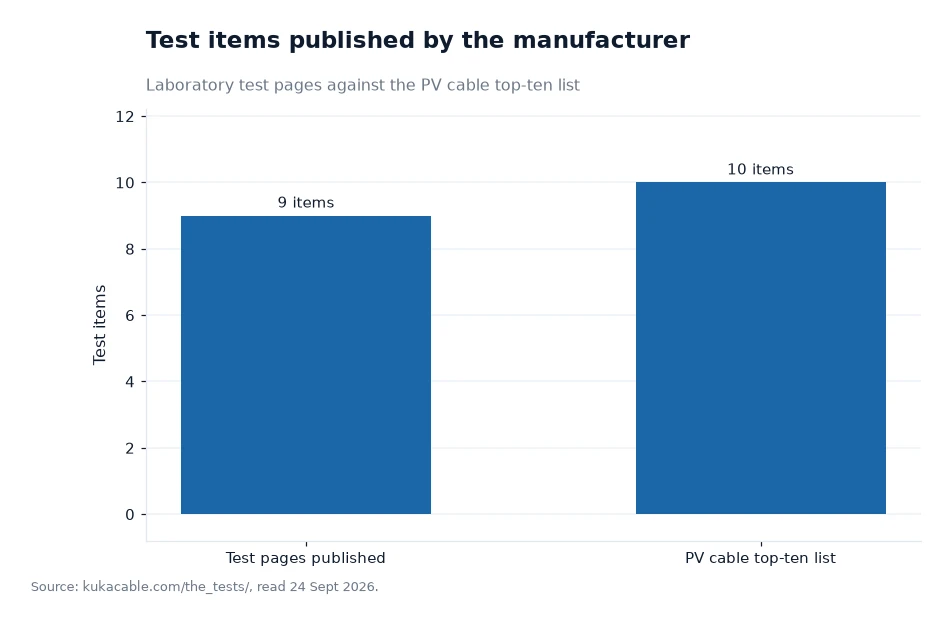
The chart below plots nine published test items against the ten carried by the client's own list. My own arithmetic on those two figures: nine is 90% of ten, so a single item separates the two counts, and that item is not necessarily missing from the laboratory work, only from the published page.
Comparisons of the two documents show they share the ground of tensile strength, environmental exposure, connectivity and dimensional checking. Conductor resistance, insulation resistance, dielectric strength and heat resistance are named only in the numbered article, while abrasion, cold bending, cold elongation and solderability appear only on the test page.
The practical use of that comparison is a short request to the supplier: map each item on your own test schedule to the report that covers it, and say which of them runs on every production batch rather than on samples alone. The client describes its SIF quality model as including 100% inspection of finished products, which is the sentence that answers the second half of that question.
Frequently asked questions
Does the manufacturer supply UL 4703 PV wire?
It lists a UL 4703 solar PV wire among its published models, and the certificates page counts more than 30 certificate types with TUV, IEC, CE, SAA and UL among them. That same page describes the UL entry as being in the process of updating, so the item to request with a North American order is the certificate that is current at the time of the enquiry rather than a line on a web page.
What should be checked on a UL 4703 PV wire datasheet?
Start with the values the manufacturer already publishes for its 1500 V solar cable: DC 1.8/1.8 kV rated voltage, a 6.5 kV AC test at 50 Hz for five minutes on the finished cable, a 10 kV spark test during production, a bending radius of 4 times the outer diameter and an ambient range of −40 °C to +90 °C. Then ask for the certificate in force and the test report for the exact size on the order.
What to put on a North American enquiry
Name the certification route, the model, the cross-section and the colour, then ask for the certificate and the data sheet for that exact construction. Moving between single-core and twin-core changes the connector, the clip and the drum count, not the certification route behind the cable.
The manufacturer offers free samples and downloadable data sheets, and describes a one-stop butler service in which a product consultant follows an enquiry from specification through delivery. Prices, order quantities and lead times are not published on the site, so they arrive with the quotation and the paperwork rather than from a catalogue page.
The UL 4703 details and test counts in this article are quoted from the manufacturer's own website; those pages were examined 24 Sept 2026[1].